Table of Contents
Handling multiple flight arrivals for a corporate group means staging one vehicle at the terminal and running rolling pickups as each flight lands, not holding the bus until the last passenger clears baggage claim, and not booking a separate car per flight. The dispatcher needs flight numbers and arrival windows for the whole group before the trip, not a single pickup time.
That sounds simple. It rarely runs that way, because most corporate travel bookings assume every flight lands inside its ten-minute window. Real arrival spreads run 45 minutes to two hours, and the plan has to survive contact with that spread.
Here is how private bus transportation actually handles a multi-flight corporate pickup, what it costs, and what changes depending on which airport your group is flying into.

What Corporate Airport Transfers Actually Involve
Private bus transportation for a corporate group is a vehicle and driver dedicated to that group’s pickup, staged at the airport for a confirmed window instead of dispatched per person. It replaces a stack of individual car services or rideshares with one coordinated trip.
The difference from a standard airport shuttle is the group size and the flight complexity. A single-flight pickup for 20 people is straightforward, one arrival time, one load, one departure. A multi-flight corporate pickup means the same 20 people land across three or four flights over an hour or two, and the vehicle has to be somewhere useful the entire time, not idling at a curb waiting for a schedule that hasn’t happened yet.
This is a coordination problem before it’s a vehicle problem. The bus itself is rarely what goes wrong.

How to Handle Multiple Flight Arrival Times
Group airport pickups fail at communication, not at logistics. The bus is almost never the problem. The problem is that nobody confirmed which terminal, which flight lands when, or what the driver does if two flights land 30 minutes apart.
The fix is a staged pickup plan built before anyone boards a plane:
Collect every flight number and arrival time, not a rough “afternoon arrivals” estimate. Four confirmed flights beat one estimated window every time.
Pick one terminal or curb as the staging point. At airports with multiple terminals, the driver needs a fixed location to return to between waves, not a moving target.
Build in buffer time. 30–45 minutes between pickup waves absorbs early landings, late landings, and the walk from gate to curb. Without it, a 10-minute delay on one flight cascades into a missed window for the whole sequence.
Name a day-of point of contact. One person on your side who can confirm a gate change or a delay in real time. Dispatchers track flights through tools like FlightAware, but a live human on the ground catches what a tracking feed doesn’t, a plane that lands on time but sits on the tarmac for 20 minutes.
(Every ground transportation company advertises real-time flight tracking. Fewer of them can tell you what happens when three of those tracked flights land within eleven minutes of each other. That’s the actual test.)
We have run this exact sequence for corporate groups landing across two and three flights inside a single afternoon. The mechanics that make it work aren’t complicated, they’re the same ones behind 700,000+ passengers and 25,000+ trips: the right vehicle stages where it’s supposed to, the driver knows the sequence before the first flight lands, and the organizer gets a confirmed plan before departure day, not a promise to “figure it out at the airport.”

Which Vehicle Fits a Multi-Flight Corporate Pickup
Most multi-flight corporate transfers run on one vehicle, sized to the full group, not the size of any single flight’s arrivals.
| Group size | Vehicle | Why it fits |
|---|---|---|
| Up to 14 | Passenger van | Small executive team on 1–2 flights |
| 15–24 | Minibus | Mid-size team across 2–3 staged flights |
| 25–40 | Mid-size coach | Larger group, wider arrival spread |
| 41–56 | Full coach | Company-wide arrival, multiple staging waves |
Sizing to the full confirmed headcount, not the largest single flight, is what most organizers get wrong. A 20-person group flying in on four flights of five people each still needs a vehicle for 20, run in four short trips, not four separate small vehicles. For a full breakdown of what each fleet size fits and when a smaller vehicle is the right call, see how to choose the right bus size and amenities.

Newark, JFK, and LaGuardia: What Changes by Airport
The staging plan changes depending on which airport your group lands at.
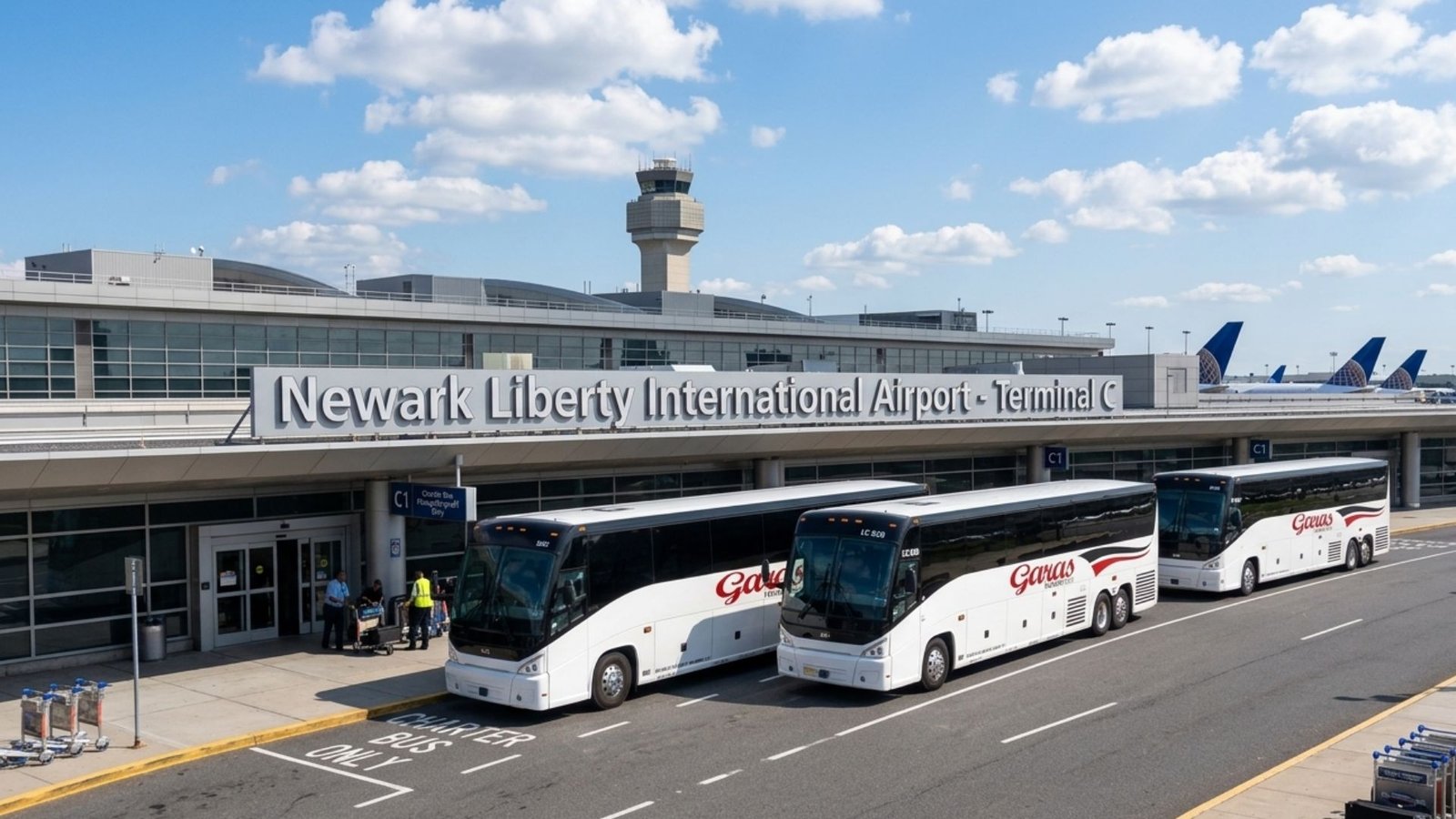
Newark (EWR) is generally the most straightforward option for New Jersey-based corporate groups. It’s the shortest drive from most Central and North Jersey offices, and its terminal layout makes staging a single vehicle for rolling pickups more predictable than the alternatives.
JFK has more terminals spread further apart, which means a staging point has to account for a longer drive between terminals if flights land at different ones. Curbside space is also tighter during peak hours.
LaGuardia sits closest to Manhattan, which makes it convenient for groups headed into the city, but its compact terminal layout means less curb space per pickup, build extra buffer time into the window. The Port Authority of NY & NJ publishes current terminal maps and ground transportation info for all three airports, worth checking before you finalize a staging plan.
None of these differences change the underlying plan, confirmed flights, one staging point, buffer time. They change how tight that buffer needs to be.
What It Costs: One Pickup vs. Staged Rolling Trips
Multi-flight corporate transfers run on the same hourly rates as any private bus transportation booking: $75–$100/hr for a 14-passenger van, $90–$140/hr for a 24-passenger minibus, $130–$180/hr for a 40-passenger coach, up to $225/hr for a 56-passenger coach, with a 3–4 hour minimum. For a full rate breakdown, see the complete charter bus pricing guide.
The real cost decision isn’t the vehicle, it’s how the pickup runs. Holding one vehicle at the airport through the entire arrival window and doing a single pickup once everyone has landed uses the fewest vehicle-hours, but the first arrivals wait around for the last ones. Running staged rolling trips, dropping the first wave at the hotel or office, then returning for the next, bills more vehicle-hours but keeps people moving instead of sitting in an arrivals hall.
Neither option is automatically wrong. A 45-minute arrival spread rarely justifies staging. A two-hour spread usually does. Confirmed flight times, not a guess, are what settles it, which is exactly why a dispatcher asks for them before quoting the trip.
Private Bus Transportation vs. Multiple Rideshares
For a group of eight or more, splitting into separate rideshares creates the same coordination problem private bus transportation solves, except with more vehicles, more drivers, and no single point of contact if a flight is delayed.
| Private bus transportation | Multiple rideshares | |
|---|---|---|
| Coordination | One dispatcher, one plan | Each rider books separately |
| Delay handling | Driver adjusts the sequence | Each rider handles their own |
| Cost structure | One hourly rate, one invoice | Per-ride, per-rider, plus tips |
| Group cohesion | Everyone arrives together | Scattered arrival times |
Under eight people on a single flight, a car service or rideshare is often the simpler call, a shuttle adds a fixed schedule to a problem that doesn’t need one. Past that threshold, or with more than one flight involved, coordinating separate cars becomes the harder logistics problem, not the easier one.
If your corporate group is landing on confirmed flights within a defined window, get the flight numbers and arrival times together before you request a quote. That single step is what turns a multi-flight pickup from a day-of scramble into a plan someone already ran.
Frequently Asked Questions
How do you coordinate a corporate group arriving on different flights?
The vehicle stages at one terminal or a shared arrivals curb, and the driver runs rolling pickups as each flight lands, instead of waiting for every passenger to arrive before leaving. That requires flight numbers and arrival windows for the group in advance, not a single pickup time. A dispatcher builds the sequence around the actual schedule, with buffer time between waves to absorb early or delayed landings.
Is private bus transportation cheaper than multiple rideshares for a group?
For eight or more people, usually yes, once you count every rideshare separately and add the coordination overhead of matching drivers to a common drop-off. A 24-passenger minibus at $90–$140/hr covers a group that would otherwise need four or five separate rideshare vehicles, each billed and tipped on its own. Under eight people, the math is closer and depends on how many flights are involved.
How far in advance should we book a corporate airport transfer with multiple arrivals?
Book as soon as flight itineraries are confirmed, ideally 1–2 weeks out for a standard multi-flight pickup. That gives a dispatcher time to build the arrival sequence and confirm vehicle availability. Fleet availability tightens around major conference dates and holiday travel weeks, so earlier is better than a definite deadline.
What happens if one of the flights is delayed?
A real operator tracks the flight and adjusts the pickup sequence, not the passenger. If a delay pushes one arrival well past the others, the driver either runs an extra short trip for that flight or holds the group slightly longer, depending on which costs less time overall. This is why flight numbers matter at booking, a dispatcher working blind can’t adjust for a delay they don’t know about.
How many vehicles do we need for a multi-flight corporate pickup?
Most groups under 40 people need exactly one vehicle, staged and run in rolling trips. Multiple vehicles only make sense when flights land far enough apart, or close enough together, that one bus physically cannot cover the arrival window without excessive wait time on either end. Confirmed headcount and flight times determine this, not a guess.
Which airport is easiest for group transportation — Newark, JFK, or LaGuardia?
Newark (EWR) is generally the most straightforward for New Jersey-based corporate groups — shorter drive from most NJ offices and a more predictable terminal layout for staging a bus. JFK and LaGuardia both work, but curbside space is tighter and traffic timing matters more, so build extra buffer into the pickup window for either one.